
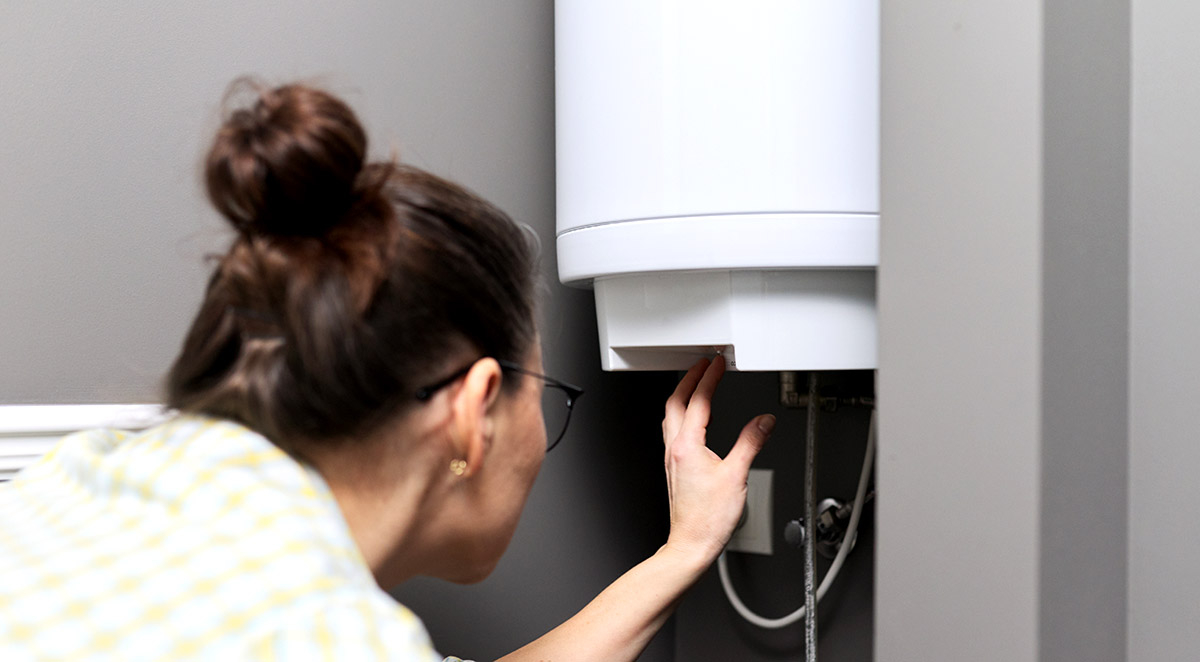
Losing hot water is one of those problems that announces itself at the worst possible moment, usually about ten seconds into a morning shower. The frustrating part is that an electric water heater has relatively few components, so the cause is often something specific and identifiable rather than a mystery. Narrowing it down is mostly a matter of paying attention to the pattern.
The symptom matters more than most people realize. No hot water at all points in one direction, while lukewarm water or hot water that runs out too quickly points somewhere else entirely. This guide walks through what each pattern usually means, what you can safely check yourself, and where the line sits between a homeowner task and a job for a licensed plumber.
Quick Summary
- No hot water at all usually means a power problem, a tripped reset, or a failed upper element
- Lukewarm or short-lived hot water usually means a failed lower element or thermostat
- Sediment buildup steals tank capacity and is common on well systems
- Always shut off power at the breaker before removing any access panel
- Water pooling at the base of the tank generally signals replacement, not repair
- Most electric tanks last eight to twelve years
- Rumbling, discolored water, or rising bills all warrant a professional look
How an Electric Water Heater Makes Hot Water
A standard electric tank heater uses two heating elements, one near the top and one near the bottom, each controlled by its own thermostat. Cold water enters through a dip tube that carries it to the bottom of the tank, where the lower element does most of the routine heating. The upper element handles rapid recovery when demand is heavy.
The two elements do not typically run at the same time. The upper thermostat has priority, so it satisfies the top of the tank first and then hands control to the lower unit. Understanding that sequence is what makes the symptoms diagnostic, because a failure in one element produces a distinctly different result than a failure in the other.
There is also a safety component worth knowing about. Behind the upper access panel sits a high-limit switch, sometimes called the ECO or energy cutoff, with a red reset button. If tank temperature climbs too high, that switch cuts power to both elements.
No Hot Water at All: The Likely Causes
When the water runs cold from the start and stays cold, the problem is almost always electrical rather than mechanical.
Tripped breaker or blown fuse
Start at the electrical panel. An electric water heater draws significant current on a dedicated 240-volt double-pole breaker, and a tripped breaker cuts the unit entirely. Reset it once and see whether hot water returns.
If the breaker trips again, stop and leave it off. Repeated tripping indicates a short in an element, damaged wiring, or a failing breaker, and continuing to reset it creates a real fire risk. That situation needs a professional evaluation.
Tripped high-limit switch
If the breaker is fine, the high-limit switch may have tripped. Shut off power to the water heater at the breaker first, then remove the upper access panel and pull back the insulation to expose the red reset button. Press it firmly until it clicks, replace everything, and restore power.
A single trip can happen for benign reasons. Repeated trips mean something is driving tank temperature too high, usually a thermostat stuck in the closed position or an element that has shorted to the tank wall. Resetting it over and over treats the symptom while the actual fault remains.
Failed upper heating element
Because the upper thermostat controls the heating sequence, a failed upper element can leave the entire tank cold even though the lower element is perfectly functional. This is the most common mechanical cause of a complete hot water loss.
Elements fail from mineral scaling, age, or from being energized while the tank was partially drained, which burns them out almost immediately. Testing an element requires a multimeter and removal of the access panel with the power off.
Some Hot Water, But Not Enough
If you get genuinely hot water that disappears faster than it used to, the problem is usually in the bottom half of the tank.
Failed lower heating element
The lower element does the bulk of the work, so when it fails you are left relying on the upper element alone. That heats only the top portion of the tank, which typically produces one short shower before the hot water is gone. It is the classic signature of a lower element failure.
Thermostat set too low or malfunctioning
Check the thermostat setting before assuming a component has failed. Water heaters are commonly set around 120 degrees, which balances comfort, safety, and energy use. A setting that has drifted low, or a thermostat that no longer reads tank temperature accurately, produces exactly the same complaint as a weak element.
Sediment buildup stealing tank capacity
Minerals settle out of the water and accumulate on the tank floor over time, and this happens faster on well systems and in areas with harder water. That sediment layer occupies volume that used to hold hot water, and it insulates the lower element from the water it is trying to heat.
The result is less hot water, longer recovery, and higher energy use. Annual flushing prevents most of this, and our water heater maintenance and troubleshooting guide covers the process step by step. Heavy, hardened buildup sometimes cannot be flushed out and requires professional attention.
Dip tube failure and undersized tanks
A cracked or broken dip tube dumps incoming cold water at the top of the tank, where it mixes with the hot water you were about to use. The tank still heats normally, but delivery temperature drops noticeably.
It is also worth asking whether the unit was ever sized correctly. If your household has grown, added a bathroom, or installed a larger tub, the tank may simply be too small for current demand rather than defective.
Water Is Warm But Never Hot
Water that is consistently warm rather than hot points to a partial heating failure or a mixing problem. One element may be working while the other has failed, or a thermostat may be cutting off early.
Another possibility is a failed or stuck mixing valve, if your system has one. These valves blend cold water into the hot supply to prevent scalding, and a malfunctioning valve adds too much cold. A crossed connection somewhere in the plumbing can produce the same effect, which is worth investigating if the problem appeared after recent work.
What You Can Safely Check Yourself
A few checks are reasonable for most homeowners, provided you take the electrical side seriously.
- Confirm the breaker is on and has not tripped
- Verify the thermostat setting matches what you expect
- Look for water on the floor, in the drain pan, or at the connections
- Listen for rumbling, popping, or crackling from the tank
- Note whether the hot water problem affects one fixture or the whole house
- Check that the unit is not in vacation mode if it has that setting
Before removing any access panel, shut off power at the breaker and verify with a non-contact voltage tester that the circuit is dead. Water heater elements operate at 240 volts, which is dangerous. If you are not comfortable confirming the power is off, that is the right point to call someone.
When to Stop and Call a Plumber
Element replacement, thermostat replacement, and wiring repairs all involve live 240-volt circuits and a tank full of water under pressure. Those are jobs for a licensed plumber, both for safety and because a mistake can damage the tank.
Signs the tank itself is failing
Some symptoms indicate the tank has reached the end of its life rather than needing a repair:
- Water pooling at the base of the tank, which usually means the inner liner has corroded
- Rusty or metallic-smelling hot water, indicating internal deterioration
- Visible rust or corrosion around the tank seams or fittings
- Repeated element failures over a short period
- Loud rumbling that persists after a thorough flush
A leaking tank cannot be repaired. Once the glass lining fails and the steel underneath begins to corrode, replacement is the only real option.
Repair or Replace?
Age is the most useful single factor. Most electric tank water heaters last eight to twelve years, and beyond that point a repair often buys limited time before the next failure. If your unit is within that window and the tank itself is sound, replacing an element or thermostat is usually sensible.
Frequency matters too. A single element failure at year six is routine maintenance, while the third repair in two years is money spent on a unit that is telling you something. Efficiency is worth weighing as well, since newer units generally use less energy than a heavily scaled tank from the previous decade.
If replacement is on the table, it is a good moment to reconsider the type entirely. Our comparison of tankless and traditional water heaters covers how each handles demand, and our gas versus electric guide is useful if you have both utilities available.
Frequently Asked Questions
Why does my electric water heater keep tripping the reset button?
A repeatedly tripping high-limit switch means tank temperature is climbing too high, most often because a thermostat is stuck closed or an element has shorted against the tank. Both require diagnosis and repair. Continuing to press the reset does not address the underlying fault and can be unsafe.
How long should an electric water heater last?
Eight to twelve years is typical, with annual maintenance pushing toward the upper end of that range. Homes on well water often see shorter service life because of faster sediment accumulation, which makes regular flushing especially valuable in our area.
Can I replace a heating element myself?
It is technically possible, but it involves shutting off power, draining the tank, removing the old element with a specialized socket, and reconnecting 240-volt wiring correctly. Energizing an element in a partially drained tank destroys it immediately. Given the electrical risk, most homeowners are better served by a licensed plumber.
Why do I have no hot water even though the breaker is on?
The most likely causes are a tripped high-limit switch or a failed upper heating element, since either can leave the whole tank cold. Checking the reset button is the logical next step after confirming the breaker, with power shut off first.
Does flushing my water heater really make a difference?
Yes. Removing accumulated sediment restores usable tank capacity, improves heating efficiency, and reduces strain on the lower element. It also removes the debris layer that causes the rumbling and popping many homeowners hear from an older tank.
Should I repair or replace a water heater that is ten years old?
That depends on the specific failure and the condition of the tank. A minor thermostat issue may be worth repairing, while a corroding tank or a second significant failure usually favors replacement. We are happy to evaluate the unit and give you an honest assessment rather than a default recommendation.
Get Your Hot Water Back
An electric water heater that stops producing hot water is usually pointing at a specific, findable cause. The breaker, the reset switch, the two elements, the thermostats, and sediment account for the overwhelming majority of cases, and the pattern of the symptom narrows it down quickly.
What follows that diagnosis is where professional help matters. Plumbing Solutions handles water heater repair and installation across Henderson, Buncombe, and Transylvania counties, and we offer emergency service during regular business hours. We will tell you plainly whether a repair makes sense or whether your money is better spent on a replacement.
Contact us to schedule service or request a free estimate.